


Hydrogels are three-dimensional networks of hydrophilic polymers capable of retaining large amounts of water. They are widely used in biomedical applications, including tissue engineering, drug delivery, and regenerative medicine. One of the most versatile components in hydrogel design is PEG45 linkers, which provide controlled spacing, hydrophilicity, and functional group versatility for crosslinking.
This blog explores:
- The role of PEG45 linkers in crosslinked hydrogel networks
- Chemistry principles behind hydrogel formation with PEG45
- Strategies to tune mechanical and structural properties
- Biomedical applications of PEG45-based hydrogels
See Blog: PEG45 Polymer Design: Ensuring Consistency and Performance


Role of PEG45 in Crosslinking Networks
PEG45 linkers act as flexible spacers and functional scaffolds within hydrogel matrices. Their primary roles include:
1.Spacer Functionality
- PEG45 provides consistent spacing between polymer chains, reducing steric hindrance and ensuring uniform network formation.
- This contributes to predictable swelling behavior and mechanical strength.
2.Hydrophilicity
- The hydrophilic PEG backbone allows hydrogels to retain large quantities of water, enhancing biocompatibility.
3.Functional Group Presentation
- PEG45 linkers can be functionalized with NHS, maleimide, azide, or amine groups, facilitating covalent crosslinking and bio-orthogonal modifications.
- PurePEG Examples:
- HO-PEG45-DSG – hydroxyl-functionalized PEG45 for direct polymer attachment
- DSPE-PEG45-NH-Mal – heterobifunctional linker for maleimide-amine conjugation
- N3-PEG45-CH2CH2COOH – azide-functionalized linker for click chemistry
Featured Products
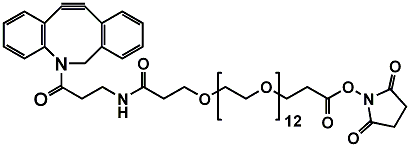


Chemistry of PEG45 Linkers in Hydrogels
Hydrogel formation typically involves crosslinking reactions between PEG linkers and complementary functional groups. Key chemistries include:
1.Amine-NHS Coupling
- NHS-functionalized PEG reacts with primary amines on polymer backbones or peptides.
- Reaction occurs under mild, aqueous conditions and produces stable amide bonds.
2.Thiol-Maleimide Conjugation
- Maleimide-functionalized PEG reacts selectively with thiols (e.g., cysteine residues) to form thioether linkages.
- Offers site-specific crosslinking with minimal side reactions.
3.Azide-Alkyne Click Chemistry
- Azide-functionalized PEG participates in copper-catalyzed (CuAAC) or strain-promoted (SPAAC) click reactions with alkynes.
- Provides bio-orthogonal, highly selective hydrogel formation, suitable for live-cell encapsulation or sensitive biomolecules.
Example Hydrogel Design Using PurePEG Products:
- Step 1: Use HO-PEG45-DSG as a polymer backbone for hydroxyl-reactive sites.
- Step 2: Introduce DSPE-PEG45-NH-Mal to crosslink thiol-containing peptides.
- Step 3: Functionalize with N3-PEG45-CH2CH2COOH for post-polymerization click chemistry modifications.
Tuning Mechanical Properties with PEG45
The length, concentration, and functionalization of PEG45 linkers directly influence hydrogel properties:
1.Crosslink Density
- Increasing PEG45 concentration or number of reactive groups enhances crosslinking density.
- Results in stiffer gels with reduced swelling.
2.Elasticity and Porosity
- Flexible PEG45 chains allow tunable elasticity, critical for mimicking tissue mechanical properties.
- Adjusting linker ratio can modulate pore size, controlling molecular diffusion within the hydrogel.
3.Degradation Rate
- Introducing hydrolytically or enzymatically cleavable PEG45 linkers enables controlled degradation, essential for drug release or tissue regeneration.
Practical Example:
- Form a PEG45 hydrogel with 50% NHS crosslinking and 50% maleimide-thiol crosslinking.
- The resulting hydrogel exhibits intermediate stiffness, high water retention, and functionalizable surface for ligand attachment.
Biomedical Applications of PEG45-Based Hydrogels
PEG45 hydrogels have been applied in numerous biomedical contexts:
1.Tissue Engineering
- Provide scaffolds for cell growth and differentiation.
- Tunable mechanical properties allow matching tissue stiffness, from soft brain tissue to stiffer cartilage.
2.Drug Delivery Systems
- Hydrophilic PEG45 matrix facilitates sustained release of hydrophobic or hydrophilic drugs.
- Functional linkers allow targeted drug conjugation, e.g., PEG45-maleimide for thiol-containing drugs.
3.3D Cell Culture and Organoids
- Biocompatible PEG45 networks support long-term cell viability.
- Bio-orthogonal modifications enable surface patterning and functionalization for complex tissue models.
4.Wound Healing and Regenerative Medicine
- Hydrogels maintain a moist environment and can deliver growth factors or peptides via PEG45 linkers.
Example PurePEG Products in Biomedical Hydrogels:
- HO-PEG45-DSG
- DSPE-PEG45-NH-Mal
- N3-PEG45-CH2CH2COOH
Optimization Strategies for PEG45 Hydrogel Formation
To achieve reproducible and tunable hydrogel properties:
1.Control Functional Group Ratios
- Adjust molar ratios of NHS, maleimide, or azide linkers for desired crosslink density.
2.Monitor Reaction Kinetics
- Ensure uniform network formation; slower reactions may produce heterogeneous gels.
3.pH and Temperature Control
- NHS reactions: optimal at pH 7–8
- Maleimide-thiol reactions: pH 6.5–7.0 for maximal efficiency
4.Post-Synthesis Functionalization
- Introduce additional PEG45 linkers for ligand attachment, fluorescence labeling, or targeting moieties.
See Blog: PEG45 Polymer Design: Ensuring Consistency and Performance
Conclusion
PEG45 linkers are versatile and high-performance building blocks for hydrogel formation. By leveraging:
- Hydrophilic, flexible spacers
- Functional groups (NHS, maleimide, azide)
- Single molecular weight consistency from PurePEG
…researchers can engineer hydrogels with precise mechanical properties, controlled degradation, and functionalization capacity for drug delivery, tissue engineering, and biomedical applications.
Recommended PurePEG Products for Hydrogel Applications:
- HO-PEG45-DSG
- DSPE-PEG45-NH-Mal
- N3-PEG45-CH2CH2COOH